Academia · 2022
NextBrain
Interactive web atlas of the human brain built from 3D histology, supporting a landmark study published in Nature.
Visit the atlas →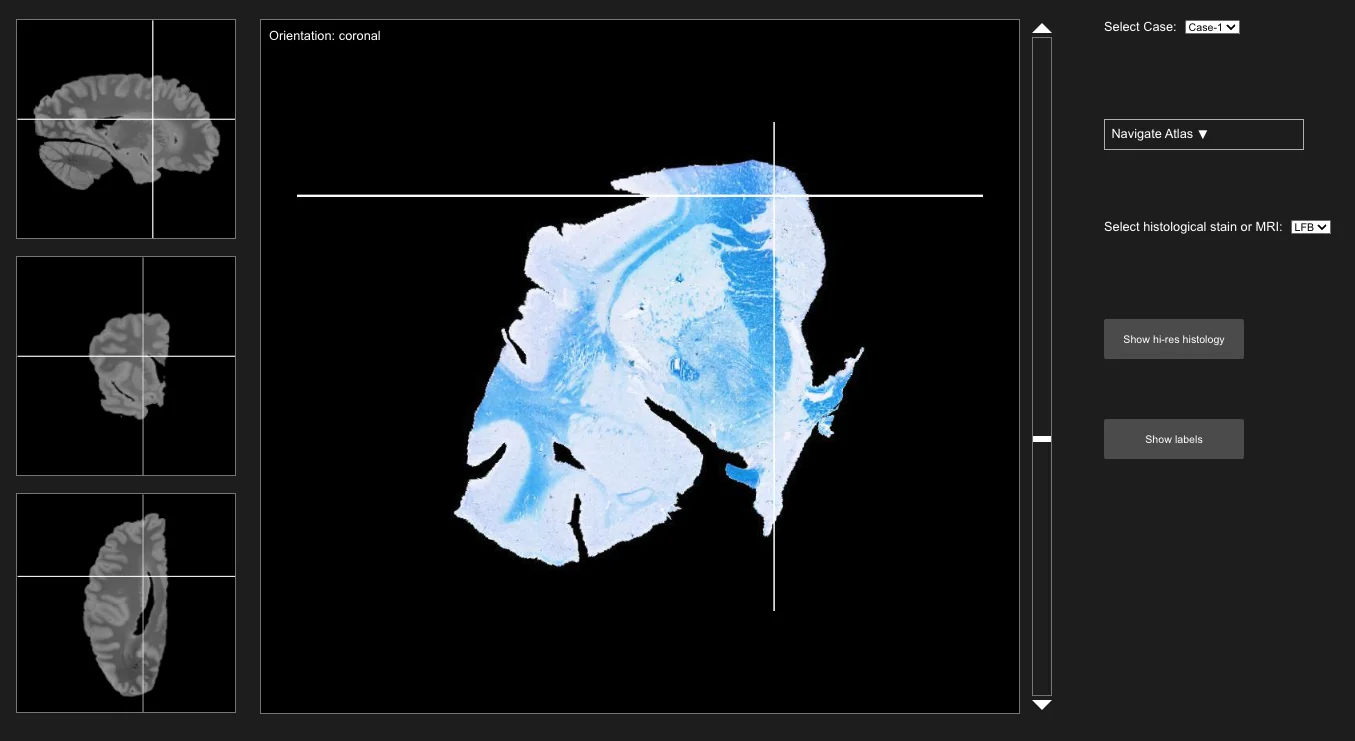
Problem
Neuroscientists at UCL needed an interactive way to share a new high-resolution atlas of the human brain with the research community. The atlas was built from 3D histology of human donor brains — dense, multidimensional datasets spanning multiple MRI and histology modalities, with fine-grained labels for hundreds of anatomical regions. The challenge was making all of this explorable in a browser, without a server, on a tight budget.
Approach
I built the interactive viewer as a pure client-side React and TypeScript application. Users can navigate synchronised MRI and histology slice views across donor brains, switch between histological staining types to reveal different cellular structures, and explore labelled anatomical regions throughout. The main technical challenge was the source data format: brain region segmentations were stored as compressed NumPy arrays (.npz), a Python binary format with no native JavaScript equivalent. I built a pipeline to handle this entirely in the browser — decompressing and parsing the binary data in real time using JSZip and npyjs — so the atlas runs with no backend infrastructure at all.
Outcome
The viewer was published as part of NextBrain — a brain atlas enabling segmentation of MRI, Hip-CT, and other scan types into hundreds of anatomical regions. The project was published in Nature, the culmination of ten years of work funded by the European Research Council and conducted in collaboration with UCL Medical Physics, the UK Dementia Research Institute, the Martinos Center at Harvard and Massachusetts General Hospital, Cardiff University, the University of Iowa, and others.